The amount of pigment in eyeshadow formulas really makes all the difference for how well they work on skin. When there's more pigment, colors look richer and more vibrant, but this comes at a cost. Shadows with over 15% mica tend to get too dry and flaky, falling off easily throughout the day. Iron oxides are another story entirely. Formulas containing more than 30% iron oxide just don't last very long on skin. Studies indicate that keeping pigments between 12% and 18% actually helps shadows stick better to skin, which means less makeup migrating toward the eyes where it can irritate. For companies making these products, testing different pigment levels through proper lab tests becomes essential. These tests should check how well makeup stays put on various skin types since what works for one person might not work so great for someone else.
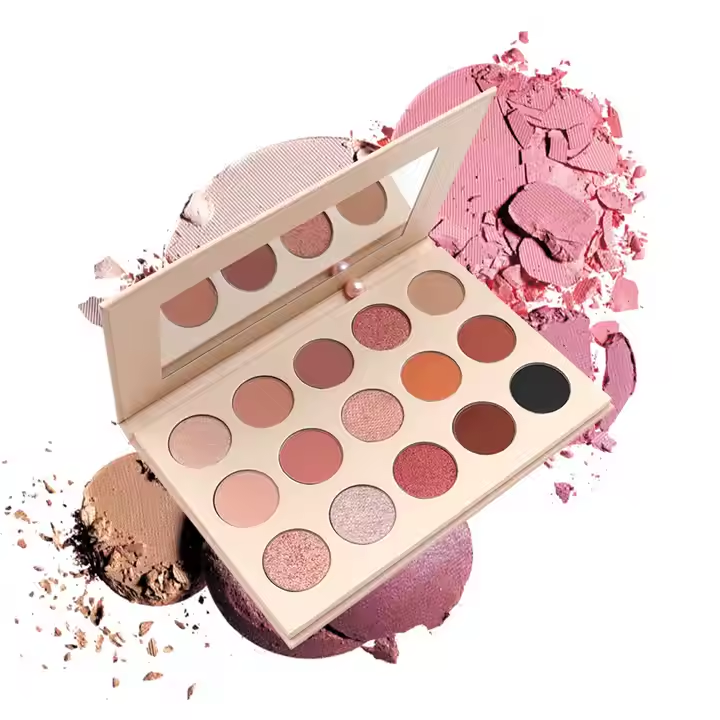
Optimal pigment loading varies fundamentally by base chemistry:
| Formula Type | Pigment Range | Key Performance Target |
|---|---|---|
| Talc-Free | 8–12% | Creamy blendability without binding overload |
| Mineral (Zinc/Mica) | 15–22% | High opacity with minimal dryness |
| Water-Activated | 25–35% | Hydration-triggered color release |
Talc-free systems require hydrophilic surface treatments to stabilize dispersion below 15%. Mineral formulas depend on micronized particles (<20 μm) to avoid grittiness above 18%. Water-activated variants need hydrophobic pigment coatings to sustain loads >25% while preventing premature activation. All formulations undergo accelerated stability testing to verify MoCRA-compliant preservation efficacy across moisture sensitivity ranges.
Top OEM companies make sure they can track where their pigments and binders come from, checking every ingredient against those official INCI names and CAS numbers we all know about. This double check system basically guarantees that everything meets the required purity levels, stays safe for use, and complies with regulations long before any actual mixing happens. When it comes to making talc free or mineral based eyeshadows, suppliers need to provide detailed records showing exactly where the minerals came from geologically and how they were processed. Water activated formulas present another challenge since they need special hydrophilic binders that have been tested for their solubility characteristics. Each batch gets its own Certificate of Analysis which shows the heavy metal content stays within strict limits lead under 10 parts per million and arsenic below 3 ppm. These tests are what actually keep colors safe and looking good on customers.
Once formulations are ready, prototypes go through accelerated stability tests that mimic what would happen over 24 months on store shelves. This involves moving them between temperatures from 4 degrees Celsius all the way up to 45 degrees, plus exposing them to controlled amounts of ultraviolet light. For microbial testing, scientists deliberately add common bacteria like Staphylococcus aureus and fungi such as Candida albicans to see how well the preservatives work. The goal is at least 99.9 percent reduction of these pathogens within 28 days. When it comes to pressed powders, we check if the binders hold onto pigments properly by dropping them from heights above 1.5 meters and running vibration tests. Cream products get their own special treatment too, undergoing centrifuge tests to make sure the oil and water phases don't separate. All these different tests help guarantee that textures stay consistent, colors remain evenly distributed, and everything stays safe from microbes even when exposed to various environmental conditions people actually encounter in daily life.
Getting compliant with MoCRA requires thorough documentation at every batch level. The Certificates of Analysis check several key parameters including pigment concentration within plus or minus 5%, binder purity levels, and strict limits on heavy metals like lead and arsenic which need to stay below 10 parts per million. For stability testing, manufacturers run colorfastness tests through thermal cycles lasting 12 weeks at 45 degrees Celsius and 75% relative humidity, plus they expose samples to UV light to ensure colors don't fade due to oxidation over time. When it comes to microbial safety, companies have to meet ISO 11930 standards showing at least a three log reduction against common pathogens such as Pseudomonas aeruginosa and Aspergillus brasiliensis after a full month's testing period. All this information needs to go into each batch's Product Information File along with detailed records of raw material CAS numbers and complete supplier audit trails. Having this kind of comprehensive traceability isn't just good practice; it actually reduces contamination risks and makes the FDA approval process much smoother since around 42 percent of all MoCRA rejection notices come from missing or incomplete PIF submissions.
Be the first to get our latest styles and offers.
Room 501, No. 279-6, Dabutou Village, Songyuansha Community, Guanhu Street, Longhua District, Shenzhen, China
Copyright © 2026 Shenzhen Joyo Cosmetics Co., Ltd. All rights reservedPrivacy policy
 EN
EN
 AR
AR FR
FR DE
DE IT
IT PT
PT RU
RU ES
ES IW
IW VI
VI TH
TH TR
TR MS
MS